Assistant Professor, Dept. Neurobiology and Anatomy, Drexel University College of Medicine
Email: respana@drexelmed.edu
hypocretin/orexin, dopamine,
norepinephrine, neural basis of addiction, behavioral pharmacology, sleep/arousal,
fast-scan cyclic voltammetry, multi-unit electrophysiology
Research and Interest
Dr. España’s research focuses on aminergic and hypocretinergic modulation of arousal-related processes including sleep/wake function, stress, and motivated behavior.
| |
| |
| |
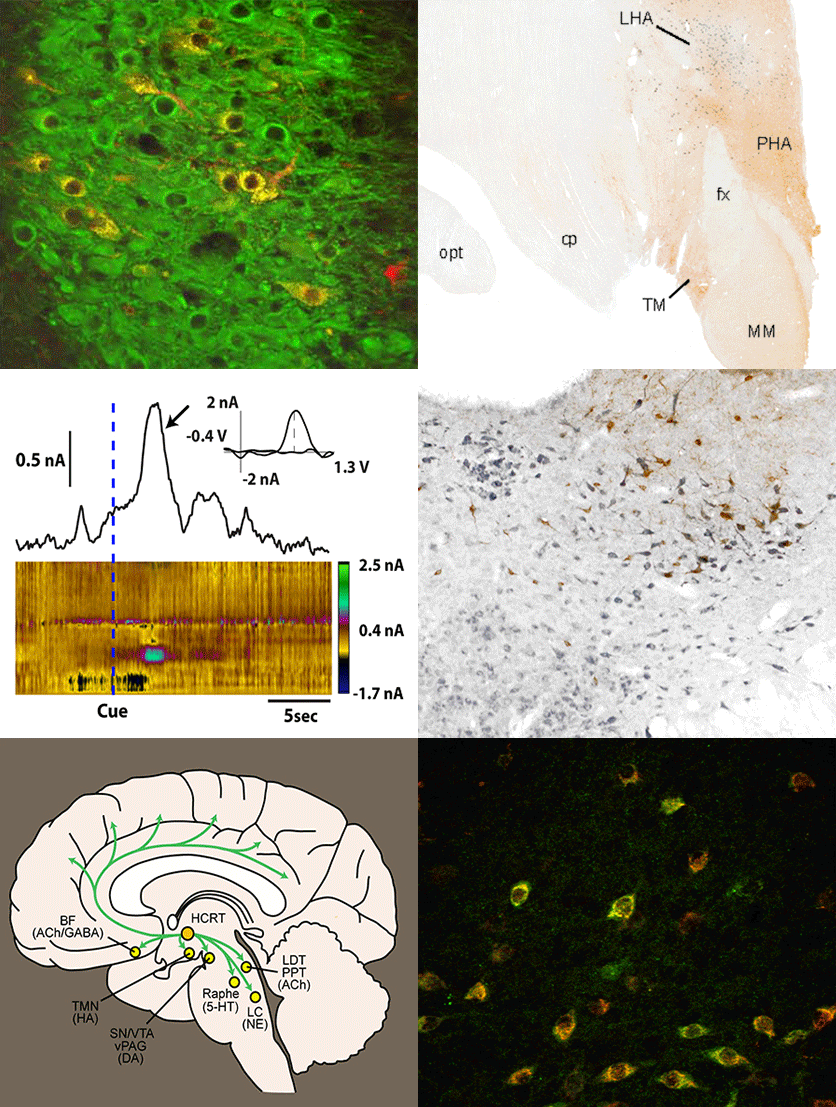
Dr. España’s laboratory uses a multidisciplinary approach to investigate the involvement of hypocretins in reward and addiction processes. Techniques include, electrophysiological recordings of sleep/wake behavior, self-administration of drugs of abuse, fast-scan cyclic voltammetry in anesthetized and freely moving animals, anterograde and retrograde tracing, and single and multi-unit recordings in behaving animals.
Biography
Dr. España received his Ph.D. from the University of Wisconsin, where his doctoral thesis focused on the behavioral and physiological functions of the hypocretins, particularly as it relates to arousal-related processes including sleep/wake behavior and stress. His postdoctoral research in the Department of Neurology at the Harvard institutes of Medicine focused on elucidating the afferent innervation of the hypocretin neurons with a particular emphasis on aminergic inputs. In this work, Dr. España showed that the hypocretin neurons receive inputs from regions that govern motivation, homeostatic drive, behavioral state, and autonomic tone. Dr. España later joined the Department of Physiology and Pharmacology at Wake forest School of Medicine, where he used behavioral and neurochemical approaches to demonstrate that the hypocretins regulate the reinforcing effects of cocaine via actions on the mesolimbic dopamine system. His current research focuses on hypocretin, dopamine, and norepinephrine regulation of arousal-related processes including sleep/wake function, stress, and drug reinforcement.
Active Funding
K01DA025279 - Hypocretin/Orexin Modulation of Reward and Addiction Processes. These studies use self-administration and microdialysis techniques in behaving rats, and voltammetry in anesthetized rats to examine whether the hypocretin system influences cocaine self-administration and whether these actions involve changes in the dopamine system.
NARSAD Award - Hypocretin regulation of dopamine neurotransmission. This study uses hypocretin knockout mice to examine the extent to which the hypocretin system is necessary for normal dopamine function under normal conditions and in response to stimulant drugs of abuse.
Lab Personnel
Rochelle M. España, Research Assistant
Collaborators & Colleagues
Sara R. Jones, Ph.D., Wake Forest School of Medicine
David C.S. Roberts, Ph.D., Wake Forest School of Medicine
Caroline E. Bass, Ph.D., University at Buffalo
Selected Publications
Yorgason, J.T., España, R.A. Jones S.R. (2011) Demon voltammetry and analysis software: Analysis of cocaine-induced alterations in dopamine signaling using multiple kinetic measures. Journal of Neuroscience Methods, 2:158-164. http://www.ncbi.nlm.nih.gov/pubmed/21392532
Yorgason, J.T., Jones S.R., España, R.A. (2011) Low and high affinity dopamine transporter inhibitors block dopamine uptake within 5 sec of intravenous injection. Neuroscience, 182:125-32. http://www.ncbi.nlm.nih.gov/pubmed/21402130
España RA, Melchior JR, Roberts DCS, Jones SR. (2011) Hypocretin 1/orexin A in the ventral tegmental area enhances dopamine responses to cocaine and promotes cocaine self-administration. Psychopharmacology (Berl), 214(2):415-426. http://www.ncbi.nlm.nih.gov/pubmed/20959967
España, R.A., Oleson, E., Locke, J.L. Roberts, D.C.S., Jones, S.R. (2010) Hypocretin/Orexin regulates cocaine self-administration via actions on the mesolimbic dopamine system. European Journal of Neuroscience., 31:336-348. http://www.ncbi.nlm.nih.gov/pubmed/20039943
Berridge CW, Espana RA, Vittoz NM. (2010) Hypocretin/orexin in arousal and stress. Brain Research., 1314:91-102. http://www.ncbi.nlm.nih.gov/pubmed/19748490
España, R.A., Roberts D.C.S., Jones, S.R. (2008) Short-acting cocaine and long-acting GBR-12909 both elicit rapid dopamine uptake inhibition following intravenous delivery, Neuroscience, 155:250-257. http://www.ncbi.nlm.nih.gov/pubmed/18597947
España, R.A., Baldo, B. A., Kelley, A. E., and Berridge, C. W. (2001). Wake-promoting and sleep-suppressing actions of hypocretin (orexin): basal forebrain sites of action. Neuroscience, 106 (4): 699-715. http://www.ncbi.nlm.nih.gov/pubmed/11682157
España, R.A., Plahn, S., and Berridge, C. W. (2002). Circadian-dependent and circadian-independent behavioral actions of hypocretin/orexin. Brain Research, 943 (2): 224–236. http://www.ncbi.nlm.nih.gov/pubmed/12101045
España, R.A., and Berridge, C.W. (2006). Organization of noradrenergic efferents to arousal-related basal forebrain structures. Journal of Comparative Neurology, 496 (5):668-683. http://www.ncbi.nlm.nih.gov/pubmed/16615125


